How to build a website like EatWith
EatWith revolutionized food experiences by connecting travelers with local hosts for authentic dining in homes worldwide. Learn how to build a similar culinary marketplace, from validating your niche to launching and scaling your platform.
Published: Aug 9, 2024
Last updated: Sep 18, 2026
What is EatWith and how does it work?
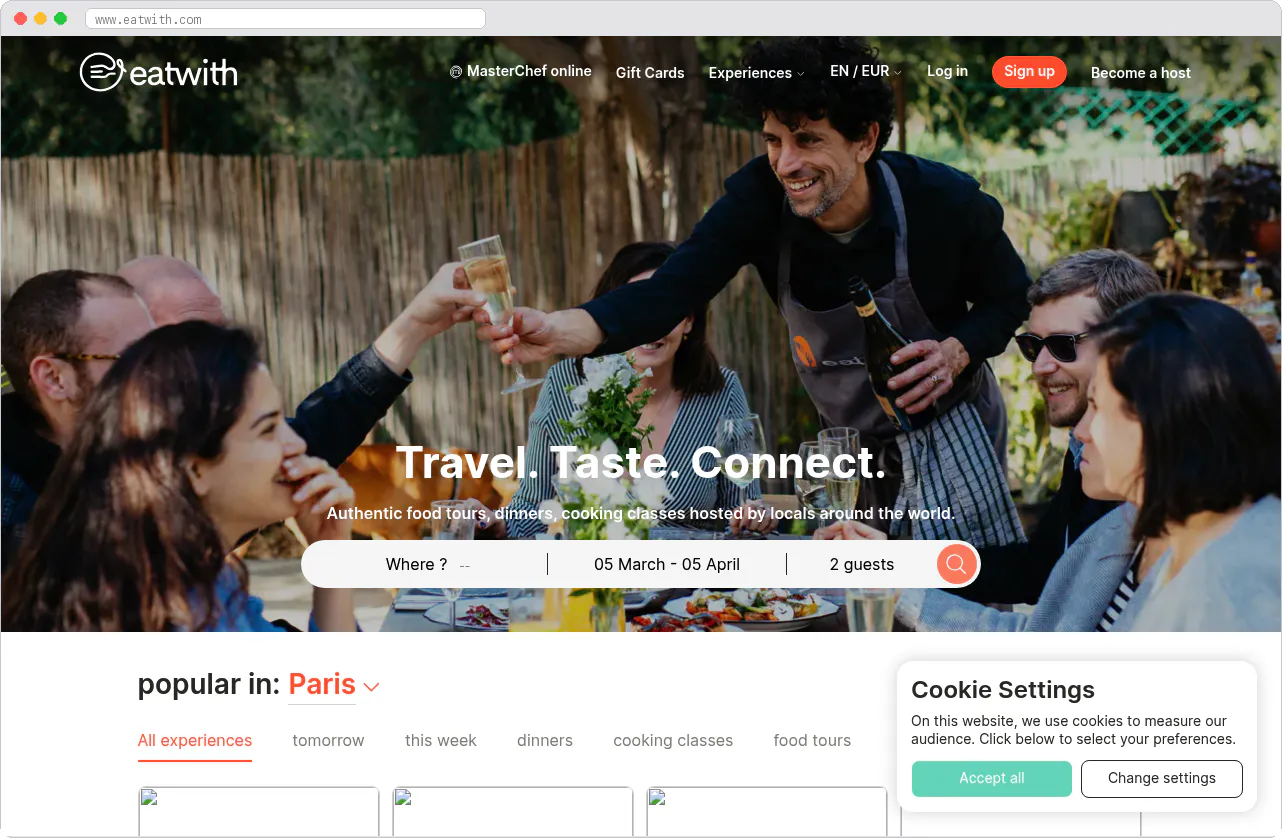
EatWith is a two-sided marketplace that connects travelers and locals with home cooks and chefs who host paid dining experiences, from multi-course dinners to hands-on cooking classes. Founded in 2012 in Tel Aviv by Shemer Schwarz and Guy Michlin, the platform grew out of Schwarz's observation that the most memorable parts of his travels happened around other people's dinner tables, not in restaurants. EatWith has facilitated hundreds of thousands of dining experiences across 130-plus countries with a host community of more than 5,000, and has raised funding from investors including Greylock Partners (Eatwith).
The mechanics are straightforward. A host lists an experience, sets a price per guest, and manages their own calendar. A guest searches by city, cuisine, or experience type, books a spot (often alongside strangers at a shared table), and pays through the platform. EatWith sits in the middle, handling discovery, messaging, payment, and the trust layer that makes it comfortable for a stranger to eat dinner in someone else's home.
How EatWith makes money
EatWith runs on a commission model layered on both sides of the transaction. Guests pay a 30% service fee added on top of the host's price, while hosts keep 100% of the price they set, since Eatwith does not take a cut from host earnings (Eatwith Help Center). Because the platform only earns when a booking happens, its incentives point toward improving conversion, trust, and repeat usage rather than charging fixed listing fees.
The unit economics favor this model because culinary experiences carry higher average order values than most experience categories. A cooking class might run $80 to $150 per person, and a multi-course dinner with wine pairings can clear $200. That gives EatWith meaningfully more commission per transaction than a marketplace selling $20 tickets, which matters when customer acquisition costs for travel-adjacent products are high.
Beyond the core commission, EatWith has tested secondary revenue streams: professional photography add-ons for hosts, sponsored placement for select experiences, and partnerships with hotels and tourism boards that refer guests directly. These remain supplementary. The commission on completed bookings is still the business.
What makes EatWith work: key features
Experience listings built for storytelling, not just booking. A cooking class isn't a commodity item, so the listing has to sell the host's personality, cultural background, and specific menu before it sells a time slot. EatWith's listing format leans on photography, host bios, and narrative description far more than a typical service marketplace would.
Flexible capacity and format handling. The same host might offer an intimate dinner for two on Tuesday and a 12-person pasta class on Saturday. The platform has to manage variable group sizes, per-person pricing, and minimum booking windows (some experiences need 24 to 48 hours of notice for shopping and prep) inside one calendar system.
Dietary and cultural context in messaging. Guests routinely need to discuss allergies, religious dietary rules, or accessibility needs before booking. EatWith's messaging isn't just a booking confirmation channel, it's where a meaningful share of pre-purchase decisions actually get resolved.
Delayed payouts. Because hosts buy ingredients and prep meals in advance but guests need refund protection, EatWith holds guest payment until after the experience, then releases funds to the host. This is standard for experience marketplaces but harder to build correctly than it sounds, since it has to account for cancellations, no-shows, and partial refunds.
Review systems tuned for authenticity, not just star ratings. The most useful EatWith reviews describe specific dishes, the host's storytelling, and the atmosphere at the table. A five-star rating alone doesn't tell a prospective guest whether the experience felt culturally genuine or merely competent.
Trust signals for entering a stranger's home. Guests are making a bigger trust decision than "will this product arrive as described." Host verification, kitchen standards, and social proof through reviews and photos all do work that a typical product marketplace doesn't need.
The competitive landscape
Airbnb Experiences is the most direct threat to any standalone culinary marketplace. It has an enormous existing user base, cross-sells food experiences to travelers who already booked a stay, and offers thousands of food-related listings globally. Where it falls short is specialization: its search filters, review prompts, and host tools are built for a generic experience category spanning hiking tours to pottery classes, not tuned for the specific needs of dietary discussion, menu detail, or culinary storytelling. That gap is exactly where a food-focused platform can out-perform on discovery and trust, even without Airbnb's scale.
Cozymeal competes for a different segment: corporate team-building, birthday groups, and structured cooking instruction led by professional chefs, rather than intimate cultural home dining. It does well with group sales and B2B bookings, which gives it a revenue mix EatWith doesn't have. It's a weaker fit for a traveler seeking a one-off cultural meal in a stranger's home, which leaves that use case relatively open.
Yhangry (formerly La Belle Assiette) takes a private chef model: a chef travels to the guest's home rather than the reverse. It targets a more affluent customer paying $50 to $100+ per person for convenience and polish rather than cultural immersion. It solves a genuinely different problem (special-occasion catering) and isn't really substitutable for home dining, but it demonstrates that "chef comes to you" is a viable adjacent business a founder could build with similar marketplace mechanics.
VizEat, EatWith's former primary European competitor, was acquired by EatWith in 2019, consolidating the two largest social dining platforms into one. That merger is worth knowing about for a specific reason: it shows that even well-funded, well-differentiated players in this category eventually found it easier to combine than to keep competing head-to-head, which suggests the category rewards deep local density more than global breadth.
Local and niche players exist in most major cities, often serving a single cuisine, immigrant community, or neighborhood. They rarely have EatWith's scale, but they frequently have tighter community trust and better retention within their niche. That's the model most new entrants should actually study, since a global culinary marketplace is a much harder build than a well-run local one.
How to build a marketplace like EatWith
1. Define your niche within EatWith's category
You're not building a global culinary marketplace clone on day one. Pick a specific wedge: a single city or region, a specific cuisine (Southeast Asian street food, Nordic home cooking), a specific format (multi-day culinary retreats, dietary-specific dining like halal or vegan), or a specific guest segment (solo travelers, business travelers, multigenerational families). The narrower the wedge, the easier it is to recruit hosts who trust each other and guests who trust the brand.
2. Validate demand before building anything
Look at existing signals in your target market: restaurant wait times, cooking class enrollment, food tour bookings, and cultural tourism volume. Talk directly to potential hosts and guests about pricing expectations, safety concerns, and what's currently missing from their options. Then test the concept manually. Build a simple landing page describing the offer, collect emails, and hand-match a handful of hosts and guests yourself before writing a line of code. This tells you more about real willingness to pay than any survey.
3. Choose your development approach
Vibe coding from scratch. AI tools like Cursor, Lovable, and Bolt can produce a working EatWith-style prototype in a weekend. For pressure-testing a concept or demoing to early hosts, that's genuinely useful. For launching a platform that holds guest payments and pays out hosts for meals served in private homes, it's probably not sufficient. What vibe-coded output reliably doesn't produce is the infrastructure underneath: payment escrow, dispute resolution, fraud detection, and compliance. A documented Sharetribe experiment ran 60+ hours to reach demo quality but revealed a critical checkout exploit that would have let any user manipulate transaction prices through a direct API call. Bringing that kind of output to production standard takes real time and a clear understanding of how the pieces fit together. A useful prototyping tool, not a cost-effective path to launch.
Custom development from scratch. Hiring developers, who will likely use AI heavily themselves, gives you full control over every detail. A culinary experience marketplace with reviews, host verification, group booking logic, escrow-style payouts, and dispute handling sits squarely in the production-grade tier: $80,000 to $200,000 over 16 to 28 weeks (Codica, RaftLabs). It lands there because guests are trusting strangers with meals in their homes, which pushes verification and dispute flow from "nice to have" to "required," and the low end of that range assumes an offshore team. Custom-from-scratch makes sense when your concept genuinely needs something no existing platform can support, not as a default starting point.
Building on a marketplace operating system like Sharetribe. You start at roughly 90% done on the standard marketplace foundation: payments, user accounts, listing management, messaging, transaction flows, fraud detection, and compliance. Your time and budget go toward what makes a food experience marketplace distinct.
- No-code builder. Configure experience listings with capacity limits, per-person pricing, calendar availability, and dietary custom fields directly in the Console. This gets most founders to a live, bookable marketplace without writing code.
- AI-assisted development. Connect Claude Code, Cursor, or Codex to Sharetribe's open APIs and open-source template to build things like automated dietary-restriction matching, host-verification workflows, or recipe-sharing features after the booking. Because Sharetribe already handles payment infrastructure, this carries much lower risk than building the same feature from scratch.
- Custom code. Build directly on the developer platform for deeper integrations (a health-department partnership API, translated messaging), or hire from Sharetribe's Expert Marketplace for work you don't want to do yourself.
Most founders start with the no-code builder, launch, and add features via AI or a developer once they know what their hosts and guests actually ask for.
4. Solve the cold start problem
Every experience marketplace has a chicken-and-egg problem: guests won't book on a platform with no listings, and hosts won't invest time creating listings for a platform with no guests. EatWith solved this by recruiting hosts one by one in specific cities, often through in-person outreach, before opening the platform to broader guest marketing.
Three tactics work for a new entrant. Go supply-first: recruit five to ten excellent hosts in a single neighborhood before you spend a dollar on guest acquisition, and hand-hold their first few bookings so the experience is genuinely good. Go geographically narrow: dominate one city block or one neighborhood before expanding, since local density is what makes a food marketplace feel alive rather than empty. And seed a niche community directly: food bloggers, cultural associations, or immigrant community groups often already have trusted cooks who'd host if asked personally. Launching small and tight beats launching broad, because a guest who finds three great options in their city converts better than one who finds thirty mediocre options scattered across a continent.
5. Recruit and onboard your first hosts
Target people who already have some food-related credibility: home cooks with a local following, former restaurant staff, cooking instructors, and people eager to share a cultural cuisine that's underrepresented locally. Offer real incentives for the first cohort, such as waived commission on their first few bookings or free professional photos for their listing. Give them direct, personal support writing their first listing, since most great cooks are not great copywriters, and a strong listing is often the difference between zero bookings and a full calendar.
6. Drive guest demand with content, not just ads
Food is inherently shareable, so lean into content: host profiles, behind-the-scenes video, and dish photography perform well on social channels aimed at travelers and local foodies alike. Partner with tourism boards, hotels, and travel bloggers who are actively looking for authentic local content to recommend. Paid acquisition works too, but early guest reviews and word of mouth from a genuinely great first cohort of experiences will do more for long-term growth than ad spend alone.
7. Get to marketplace liquidity, then expand
Track booking rate, repeat guest rate, and host response time as your core health metrics. Once a neighborhood or city consistently fills experiences and hosts are earning meaningfully, you have proof of a repeatable formula. Expand to adjacent neighborhoods or a second city only once the first market is genuinely dense, not before. Spreading thin across five cities with two hosts each produces a worse guest experience than owning one city properly.
Do you need to build everything EatWith has?
No. EatWith spent over a decade building multi-currency support, kitchen inspection programs in specific markets, an internal translation layer for cross-border messaging, and a global host success team. None of that is required to launch. What's essential at launch is a working listing and booking flow, secure payment with delayed payout, messaging that supports dietary and logistics questions, and a review system. Everything else, from professional photography packages to sponsored placements, is an optimization you add once you have real usage data telling you it matters.
The "I'll just vibe-code a version of this" instinct is understandable, but the math doesn't favor it. Even with AI tools doing most of the typing, you still have to build and test payment escrow, refund logic for cancellations, and host payout timing correctly, or you risk exactly the kind of exploit the Sharetribe vibe-coding experiment surfaced: a checkout flow that let any user manipulate transaction prices directly. Starting on a foundation like Sharetribe means that layer already exists and is already tested. Your AI coding budget goes toward the dietary-matching feature or the host-verification workflow that actually differentiates your platform, not toward re-solving payment security from zero.
Trust and safety for a EatWith-type marketplace
The core risk in a home dining marketplace is different from a typical goods or services marketplace: guests are entering a stranger's private home, and hosts are letting strangers into that home while handling food safety themselves. That combination raises the trust bar on both identity verification and physical safety in a way that, say, a freelance marketplace doesn't face.
Standard practice in this space includes identity verification for hosts before their first listing goes live, a review system that explicitly prompts for food quality and host hospitality (not just a generic star rating), and clear cancellation and refund policies communicated before booking, since last-minute cancellations hit both sides hard given ingredient costs. Some markets add kitchen or hygiene self-certification, though full health-department inspection is uncommon outside a handful of regulated regions.
Sharetribe provides the foundational layer out of the box: secure payment holding until after the experience, structured transaction flows that support cancellation and refund logic, and user accounts that support optional identity verification. What founders need to add is category-specific: a dietary-restriction disclosure flow, a host code of conduct around food safety, and, if operating in markets with legal requirements around food service in private homes, a review of local regulation before launch. That last piece is a legal question worth answering with a local lawyer, not something a marketplace platform can solve generically.
Running a marketplace like EatWith
Day-to-day operations for a culinary experience marketplace lean more hands-on than a pure product marketplace. Someone on your team needs to review new host listings for quality and completeness, monitor early reviews for red flags, and be reachable when a guest has a last-minute dietary question or a host needs to cancel due to illness. This is real work, but it's manageable at small scale with a founder or a single ops hire; it becomes a real staffing question only once you're running dozens of experiences a week across multiple markets, which is a problem you solve after you've proven the model, not before.
What you won't need to build yourself: payment processing and payout logic, the transaction record and booking calendar, messaging infrastructure, or the underlying hosting and uptime of the platform. Sharetribe handles all of that automatically, which is precisely the part of the business that has nothing to do with why a guest chooses your food experience over someone else's.
Development costs and timeline
Three realistic scenarios:
Vibe coding from scratch: Free or very cheap to start. A working EatWith-style prototype, with listings, a calendar, and a basic checkout, is buildable in a weekend with AI tools. What you can't get from here is a production-ready platform: verified payment escrow that survives edge cases like partial refunds for dietary substitutions, a dispute resolution flow, and fraud protection against fake listings or manipulated pricing all require work that AI coding tools don't shortcut. A documented Sharetribe experiment logged 60+ hours to reach demo quality and still found a critical payment vulnerability. A useful proof-of-concept tool, not a cost-effective path to a live business.
Custom development from scratch: Cost depends on complexity tier. Because a culinary experience marketplace needs host verification, reviews, dispute handling, and delayed payouts to function safely, it sits in the production-grade tier: $80,000 to $200,000 over 16 to 28 weeks (Codica, RaftLabs). The low end assumes an offshore development team; US or Western European teams push toward the top of that range or beyond. Ongoing maintenance typically runs 15% to 25% of the original build cost per year on top of hosting. This path makes sense once you have specific requirements, like a proprietary chef-matching algorithm or a regulated food-safety integration, that no existing platform supports.
Building on Sharetribe: Subscription pricing starts at $99/month on the Lite plan, $199/month on Pro, and $299/month on Extend, all billed yearly. This covers the transaction engine, payment processing and payout logic, listing and search infrastructure, messaging, and compliance foundation for a culinary experience marketplace. Most founders reach a live, bookable MVP in weeks, not months, and any custom feature they add through AI tools or a developer is scoped narrowly because the core marketplace mechanics are already built and tested.
Why Sharetribe for building a marketplace like EatWith
Sharetribe's transaction engine already supports the mechanics that matter most for a home dining marketplace: per-person pricing, calendar-based availability, and delayed payouts that hold guest payment until after the experience is delivered. Its integration with Stripe Connect handles the payment splitting between guest, host, and platform commission automatically, which removes a meaningful chunk of the custom development a culinary marketplace would otherwise need. Built-in review and messaging systems give you the trust infrastructure guests need before eating in a stranger's home, and the platform's flexible listing schema lets you add culinary-specific fields (dietary tags, group size limits, cuisine type) without touching code. From there, the no-code Console gets you to launch, and AI-assisted development or a developer hire lets you layer on whatever makes your specific culinary niche distinct.
Frequently asked questions
How much does it cost to build a website like EatWith?
Custom development for a production-grade culinary marketplace with host verification, reviews, and delayed payouts typically runs $80,000 to $200,000 over 16 to 28 weeks with an agency (Codica). Building on Sharetribe cuts initial cost dramatically, with plans starting at $99/month and most founders reaching a live MVP in weeks.
What features are essential for a culinary experience marketplace?
You need experience listings with rich media and per-person pricing, calendar and capacity management for variable group sizes, messaging that supports dietary and logistics discussion, a review system built around food quality and hospitality, and delayed-payout payment processing that protects both hosts and guests.
How do I find hosts for a food experience marketplace?
Target home cooks and cultural cooks with some existing following, former restaurant staff, and cooking instructors, and recruit them in person through food festivals, farmers markets, and cultural community groups. Offer incentives like waived commission on early bookings and free listing photography, and give hands-on support with their first listing.
What makes EatWith different from Airbnb Experiences?
EatWith specializes exclusively in culinary and cultural dining experiences, with listing fields, review prompts, and host tools tuned to that use case. Airbnb Experiences has far more reach and cross-sells to travelers already booking accommodation, but its generalized tools are less suited to the specific needs of food hosts and dietary-conscious guests.
How do culinary experience marketplaces make money?
Most run on commission, typically 8% to 15% on the host side and a 5% to 15% service fee on the guest side. Higher average order values ($50 to $300+ per person) make this sustainable even with meaningful customer acquisition costs.
Is it legal to run a home dining marketplace?
Rules vary significantly by country and even by city, covering food safety, home business permits, and sometimes zoning. Some markets require a cottage food license or health permit for hosts serving paid meals from a private kitchen, so a founder should get local legal guidance before launch rather than assuming EatWith's model transfers directly.
Start your 14-day free trial
Create a marketplace today!
- Launch quickly, without coding
- Extend infinitely
- Scale to any size
No credit card required